
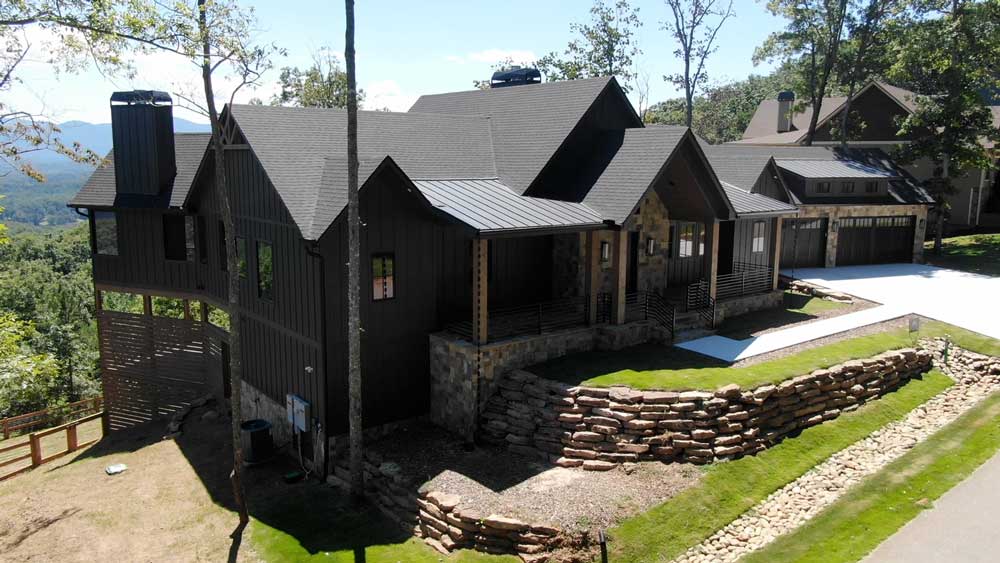
Finding a beautiful piece of property can feel like the beginning of your custom home story. In North Georgia, much of the appeal is rooted in nature. Appalachian homes are known for long-range views, native flora, wildlife, and natural rock outcroppings. Mountain homes are often surrounded by trees and seem to become one with the mist that rises through the mountains after a rain. Maybe there is a sweeping lake view just beyond the tree line, a creek running along the property, or enough acreage that your future front porch feels completely removed from the rest of the world.
It is easy to stand on a piece of land like that and immediately begin imagining the home that belongs there. And, in many ways, that is exactly where good mountain home design begins: with the land.
Building in the mountains is as much about understanding what should remain as it is deciding what should change. The trees that provide privacy and help hold a hillside, an outcropping of boulders that gives a property its character, the natural path water takes after a hard rain, and the slope that opens up a remarkable view are all part of the site.
The goal is to work with the mountain so the finished home feels like it belongs there. Especially because the mountain will win that argument anyway.
Mountain land demands a little humility. Water runs where water wants to run. Rock has no interest in your construction schedule. And a road that looks perfectly reasonable from the front seat of an SUV can become a very different conversation when you are trying to walk the property, cut in a driveway, or bring construction equipment up a narrow, steep approach.
Thoughtful land preparation means working with the property so the finished home feels like it belongs there while protecting the things that made you want the land in the first place. It also means understanding that the purchase price is only one part of the decision: the site may bring its own requirements for access, utilities, drainage, excavation, and design.
That is why evaluating land for a custom home should happen before you become too committed to a particular house plan or, whenever possible, before you purchase the property. In fact, builders like Fine Line Builders often provide free initial consultations and preliminary evaluations prior to purchase (sometimes using just site photos or listing photos) to help buyers gain clarity and avoid major, costly purchasing mistakes before committing to a site.
At Fine Line Builders, we build one-of-a-kind custom homes throughout North Georgia. More often than not, those homes are shaped by the mountains themselves: the slope, views, trees, rock, access, sunlight, water, and everything else that means no two properties are ever alike.
Most of the land in question is mountainous or hillside property, but North Georgia also has rolling hills, valley parcels, and occasional pockets of semi-flat land. These sites may not present the same grade-related challenges as a steep mountain lot, but they still require careful evaluation. Valley and lower-lying properties can involve large banks, wetlands, saturated soils, drainage concerns, floodplain considerations, limited usable building areas, and other challenges created by their position in the landscape.
Before you buy property, evaluate everything that comes with it.

What Should You Look for When Buying Land for a Custom Home?
When you first walk a property, you will probably notice the things that brought you there: mature hardwoods holding the quiet of the forest floor, a hawk settling into the high branches of a tulip tree, the way mountain laurel frames the edge of a path, or the cool hush that seems to deepen beneath the canopy. You may notice the scent of damp earth after rain, the sound of a creek below the ridge, the changing light through the trees, or the feeling that the land offers a kind of peace that cannot be measured in acreage. Those details are not incidental. They are part of what the property is offering, and they may shape the home more meaningfully than privacy or a long-range view alone.
A builder evaluates the same property looking at all of that and several less romantic things.
Where can the house realistically sit? How will water naturally move across the property, and where are there gullies or gulches that make its path evident? What happens during a hard North Georgia rain? How will construction equipment get in? Where are the utilities? What will have to be excavated? What should be left alone?
On rolling hills or valley land, the questions may be different but no less important. Where are the low points? Are there wetlands, wet soils, floodplain areas, or large banks that limit the usable building area? Will drainage need to be managed across a broad, gently sloping site? Does the land appear easy to build on simply because it is not steep, or are there other site conditions that could affect the home, septic system, driveway, or foundation?
A good custom home building lot needs to support the house you want to build without destroying the property you wanted in the first place.
Start With the Terrain, Not the Floor Plan
Slope is one of the biggest considerations when buying land to build a house in North Georgia, but a sloped lot is not necessarily a bad lot.
Quite the opposite.
Some of the most spectacular mountain homes are possible because of the slope. A hillside can create the opportunity for a walkout basement, layered outdoor living spaces, walls of windows, dramatic elevations, and long-range views you simply could not get on flat ground.
The right approach is to let the land influence the house instead of arriving with a floor plan and insisting the mountain accommodate it. The mountain did not receive a copy of your floor plan and it isn’t going to make accommodations for you. It is ancient, stubborn, and completely uninterested in learning the language of your blueprints.
Slope influences excavation, foundations, drainage, retaining walls, driveway placement, outdoor spaces, and the home’s orientation. The difference between designing for a slope and fighting against one can affect both the character of the finished home and the construction budget.
Rolling hills and valley parcels may offer a gentler grade and a more straightforward building approach, but that does not make them automatically simple. Large banks, wetlands, poor drainage, floodplain restrictions, saturated soils, and other low-lying site conditions can limit where the home, septic system, driveway, and outdoor spaces can go. The terrain may be easier to walk, while the site still requires significant planning to manage water, protect sensitive areas, and create a stable, usable building area.
Look at What You Can Preserve, Too
Land preparation does not automatically mean clearing everything within sight of the future house.
Those mature hardwoods may be part of the reason the property feels secluded. Red oaks can frame a future porch with russet leaves in autumn, while wild ferns glisten with dew beneath them on a cool mountain morning. Native mountain laurel, sourwood, and dogwood can add seasonal color without making the home feel planted onto the land. Existing vegetation can also help stabilize soil and manage runoff. Natural rock formations may become part of the home’s landscape rather than something that needs to disappear. Existing contours can create privacy between outdoor spaces or help a home settle naturally into its surroundings.
There will always be clearing and disturbance involved in construction. The question is whether it is intentional.
Before removing trees or substantially altering a site, determine what is there, what needs to go, what should stay, and how those decisions affect drainage, views, privacy, erosion, wetlands, sensitive areas, and the finished home.
Sometimes the best feature on the property is one you didn’t build.
Don’t Just Ask Whether You Can Get There. Ask Whether We Can Build There.
You drove up the road and made it to the property. Excellent.
Now imagine walking the property on foot to find the homesite, then creating a driveway where no driveway currently exists. In many North Georgia properties, access may require cutting through a bank at the edge of the road and building retaining walls on one or both sides of the driveway. The approach may be narrow, steep, uneven, or difficult to navigate even before construction begins. Now imagine doing all of that while dragging an excavator on a 24-foot heavy-duty trailer.
Heavy construction access is one of those considerations that can be easy to overlook when buying a mountain home building lot. It is not enough for a passenger vehicle to reach the general property; you need to determine whether there is a practical way to reach the homesite, create access, and bring the equipment and delivery vehicles required to build the home safely and efficiently.
That may include skid steers, bulldozers, dump trucks, bucket trucks, concrete trucks, pump trucks, lumber deliveries, trusses, dumpsters, cranes, and other heavy equipment.
There are a couple things that you need to know BEFORE you start construction:
- How steep is the road or proposed driveway?
- How narrow is the approach?
- Are there tight switchbacks, sharp turns, drop-offs, or unstable shoulders?
- Can a large truck make the turn?
- Is there enough room at the building site for equipment to maneuver?
- Can materials be staged safely?
- Is the road public or private?
- Who maintains it?
- Are there bridges, culverts, weight limitations, gates, or easements between the public road and your property?
Walking the property may itself require careful footing, clearing, or off-road access before you can even determine where a home could go. A road that works beautifully for your Subaru, may send the person delivering your roof trusses into a fit.
Difficult access does not automatically mean the property cannot be built on. It does mean access must be evaluated before you buy, because steep drives, road improvements, temporary construction access, equipment limitations, retaining walls, and material staging can add substantial cost to the project. A site may be completely buildable, but if reaching it requires more time, labor, equipment, or infrastructure than expected, those costs become part of the real price of the land.

Utilities Can Be “Available” and Still Be a Long Way Away
Another important part of a land evaluation before buying is understanding utilities and infrastructure. Determine whether electricity, public water, cable, and reliable internet are available at or near the property.
Pay special attention to those last three words: near the property.
Electricity at the road and electricity at the house are not necessarily the same financial experience.
If your ideal homesite sits several hundred feet into a larger parcel, utilities may need to travel that distance too. Depending on the property, that can mean trenching, additional poles, water lines, communications infrastructure, or other site work.
Public sewer is generally not available in these mountain areas, though limited sewer system access exists within the city limits of Hiawassee, Young Harris, and Blairsville. While Fine Line Builders does not build within city limits very often, it is not completely unheard of. Most homes in the area rely on private septic systems, so septic feasibility needs to be evaluated early. If public water is unavailable, you will also need a well.
For buyers relocating to the North Georgia mountains from more developed areas, these are easy things to take for granted. Turning on a faucet is wonderfully simple. Getting everything necessary to make water come out of it on previously undeveloped mountain land can be considerably less so.
Hidden Costs That Can Turn an Affordable Lot Into an Expensive Project
This is where the conversation about purchase price finally matters, because a lower-priced property is not necessarily the less expensive place to build.
Two pieces of North Georgia land can have similar acreage and similar asking prices while requiring dramatically different amounts of land preparation for home construction.
Before construction begins, a property will require some combination of:
- Clearing and selective tree removal
- Grading and excavation
- Rock excavation
- Erosion-control measures
- Retaining walls
- Driveway construction
- Culverts and drainage systems
- Well installation
- Septic installation
- Utility extensions
- Surveys and engineering
- Permits
- Specialized foundation work
- Wetland, floodplain, or environmental review
- Soil stabilization or other measures for saturated or unstable ground
This is why we prefer to think about the cost of the property plus the site, rather than looking at the purchase price of the land in isolation.
Rock Is Gorgeous Until It’s Where Your Foundation Goes
North Georgia has no shortage of beautiful exposed rock. It is one of the features that gives mountain property its character.
It is considerably less charming when you discover a great deal of it exactly where excavation needs to happen.
Subsurface conditions can affect the equipment, labor, time, and expense required to prepare a homesite. Some conditions can be investigated ahead of time. Others may not reveal themselves completely until work begins.
This is one reason site-development budgets need room for reality. Rock does not care what the survey said.
Make Sure the Property Can Support the Septic System You Need
For every rural and mountain property in this area, there is no municipal sewer service. Septic is the standard way homes handle wastewater here, so the property must be able to support a private septic system.
The soil, slope, available area, number of bedrooms, and location of the proposed home can all influence septic planning.
On rolling hills and valley land, septic planning may also be affected by wet soils, wetlands, floodplain areas, drainage patterns, and the amount of usable ground outside those restricted or sensitive areas.
And acreage can be deceptive. Owning five acres does not necessarily mean you have five acres available for whatever you would like to put wherever you would like to put it.
The septic field has to go somewhere. So does the house. So does the driveway. And ideally none of them should be fighting over the same piece of usable ground.

In the Mountains, Pay Attention to Where the Water Wants to Go
If there is one thing mountain property will eventually demonstrate for you, it is where water wants to go.
It is much better to learn that before the house is built.
Heavy rainfall moving across sloped terrain can create runoff, erosion, drainage problems, saturated soil, and pressure against foundations and retaining structures when the site is not properly planned.
On rolling hills and valley properties, water may move more gradually, but that does not mean it is harmless or easy to manage. Low points, wetlands, broad drainage areas, saturated soils, and floodplain conditions can affect the location of the home, septic system, driveway, and construction access. A site that appears relatively flat may still require careful grading, drainage design, environmental review, or restrictions on where land can be disturbed.
Trees, vegetation, natural contours, ditches, culverts, retaining systems, and engineered drainage can all play roles in managing water around a mountain home.
This is another reason conservation and construction planning belong in the same conversation. Clearing vegetation and reshaping land changes how water moves across it.
You cannot convince the rain that it should avoid your house. Good mountain construction anticipates water rather than arguing with it afterward.
How the Land You Buy Should Influence Your Custom Home Design
One of the greatest advantages of building a true custom home is that the house can be designed for the property rather than forcing a predetermined house onto it.
That means asking more interesting questions than whether the floor plan fits.
Where does the sun rise? Where does it set? Which direction gives you the best mountain view? Which trees create privacy? What do you see from the primary bedroom when you wake up? Could the slope naturally accommodate a lower level? Where should the porch go if you actually want to use it throughout the year? How will guests approach the house? Where will water travel during a summer thunderstorm?
A steep slope may make a walkout basement practical. A narrow building area may influence the footprint. The septic field may affect outdoor living areas. Drainage may influence driveway placement. A spectacular western view might change where the primary living spaces belong.
On a rolling hills or valley property, the design may be shaped less by dramatic grade and more by wetlands, large banks, drainage patterns, floodplain limitations, soil conditions, or the need to preserve a practical septic and building area.
This is the fun part of building a one-of-a-kind home.
Instead of asking, “How do we make this floor plan work on this property?” we can ask:
“What does this property let us build?”
That is a very different design conversation.
Questions to Ask Before You Buy Land in North Georgia
A view can make you fall head over heels in love with a property. But, before you propose marriage, you should ask a few questions to make sure you’re compatible.
When considering land for a custom home, you should work with a qualified local realtor and find out:
- How is the property zoned?
- Are there deed restrictions?
- Is there an HOA or architectural review process?
- Are there minimum home-size requirements?
- What setbacks apply?
- Are there easements across the property?
- Has the property been surveyed recently?
- Is any portion within a designated flood zone?
- Are there streams, wetlands, or other environmentally sensitive areas?
- Has the soil been evaluated for septic?
- Is public water available, or will you need a well?
- Where is electrical service?
- Is dependable high-speed internet available?
- Is the road public or private?
- Who maintains the road?
- Can you safely walk and evaluate the property?
- Will a driveway need to be cut in?
- Will the driveway require cutting through a bank or building retaining walls?
- Is the approach narrow, steep, or difficult to navigate?
- Can construction vehicles safely reach the homesite?
- Are there restrictions on tree removal or land disturbance?
- What is planned for surrounding properties?
- Where does water naturally move across the site?
- Are there large banks, wetlands, wet soils, or low-lying areas that limit the usable building area?
- How much of the acreage is realistically usable for the home and the way you want to live?
Your realtor can help you locate property records, identify known restrictions, request available disclosures, coordinate access, and connect you with the appropriate county offices and professionals. They can also help you understand the purchase contract, due diligence period, contingencies, and deadlines that may give you time to investigate the property before closing.
County GIS systems and property records are useful places to begin researching parcels, boundaries, zoning, flood information, and surrounding property. Environmental resources from the Georgia Department of Natural Resources can also help when streams, wetlands, protected resources, or other environmental considerations are involved.
Online research is the beginning of a land evaluation before buying, not the end. A parcel map cannot stand on the side of the mountain with you and say, “You know, I don’t love what that water is doing over there.”
Your realtor can help coordinate the right conversations. An experienced builder can offer early feasibility checks or preliminary feedback from listing photos, especially in areas like Towns County where local terrain and conditions are already well known. While full in-person field visits are reserved selectively for serious projects, involving a builder early alongside surveyors, soil professionals, engineers, or septic evaluators can prevent major purchase mistakes before you close.

Work With a Realtor Who Understands Land Purchases
It is vastly important to work with a realtor who understands land purchases, especially when you are considering rural, mountain, or undeveloped property. A knowledgeable realtor can help you identify the questions that need to be answered before you buy and connect you with professionals who can fully evaluate the land for building.
A realtor who regularly works with rural, mountain, or undeveloped property can help you understand the practical side of a parcel before you become emotionally or financially committed to it. They may be familiar with local roads, subdivisions, county requirements, common deed restrictions, private-road arrangements, and the kinds of questions that need to be answered during due diligence.
When interviewing a realtor, ask:
- How often do you help clients buy vacant or undeveloped land?
- Are you familiar with mountain and rural properties in the areas we are considering?
- What should we investigate before making an offer?
- Which contingencies or due diligence periods should we discuss with our attorney?
- Can you help us obtain surveys, plats, restrictions, disclosures, and utility information?
- Who should evaluate the soil and septic feasibility?
- How can we verify road access and maintenance responsibilities?
- Can you coordinate property access for a surveyor, engineer, or septic professional?
- What county offices or local professionals should we contact?
- Are there nearby developments, road projects, zoning changes, or other plans that could affect the property?
A realtor can help you ask better questions and connect you with the right professionals, but a complete land evaluation may require input from a surveyor, soil professional, septic evaluator, engineer, attorney, builder, or other specialist. No single person can confirm every subsurface condition, drainage issue, or construction consideration before closing.
The right realtor can help you organize the investigation and understand what needs to be confirmed before you purchase.
When building a custom home in North Georgia, involving your builder early in the process, even before you buy the land, can help you evaluate a property’s potential and avoid costly mistakes. Len and the team at Fine Line Builders offer free initial consultations to assist prospective buyers prior to purchase.
Already Own Your Land? Don’t Start Clearing Yet.
If you have already purchased your property, you have not missed the opportunity to make smart decisions about it. But before somebody shows up with a chainsaw and enthusiasm, make a plan.
Once mature trees are gone, they are gone. Once a hillside has been substantially disturbed, putting it back is considerably more complicated than leaving the right parts of it alone in the first place. Before clearing trees, cutting a driveway, or committing to a floor plan, understand how the house and property should work together.
The right planning can preserve the features that made you fall in love with your land, reduce unnecessary site work, protect the home from problems that can develop later, and help you spend your construction budget where it adds the most value.
Learn more about Fine Line Builders and our approach to creating one-of-a-kind mountain homes, or schedule a consultation to talk with our team about your land and what you hope to build there.
0 Comments